Book a free first hour
Free first hour (SAT and ACT)
Draft, sample content

Small gaps.
A giant difference.

Most stuck scores aren't a talent problem. They're four or five question types, repeated. Rick, a 99th-percentile scorer, finds yours in a free first hour and fixes exactly those, one-on-one, until the number matches the student.

SAT and ACT: the first hour is free, no card. LSAT starts with a proctored diagnostic. PSAT, GRE, GMAT and MCAT are waitlist for now.

Taught by Rick, founder, 99th percentile. One tutor in every session.

Where our students have goneSample
PrincetonMITHarvardStanfordYaleCaltechDukeJohns HopkinsNorthwesternPennCornellUChicagoBrownColumbiaDartmouthUCLAUC BerkeleyRiceNotre DameVanderbilt

The test has a pattern. Almost nobody is shown it.

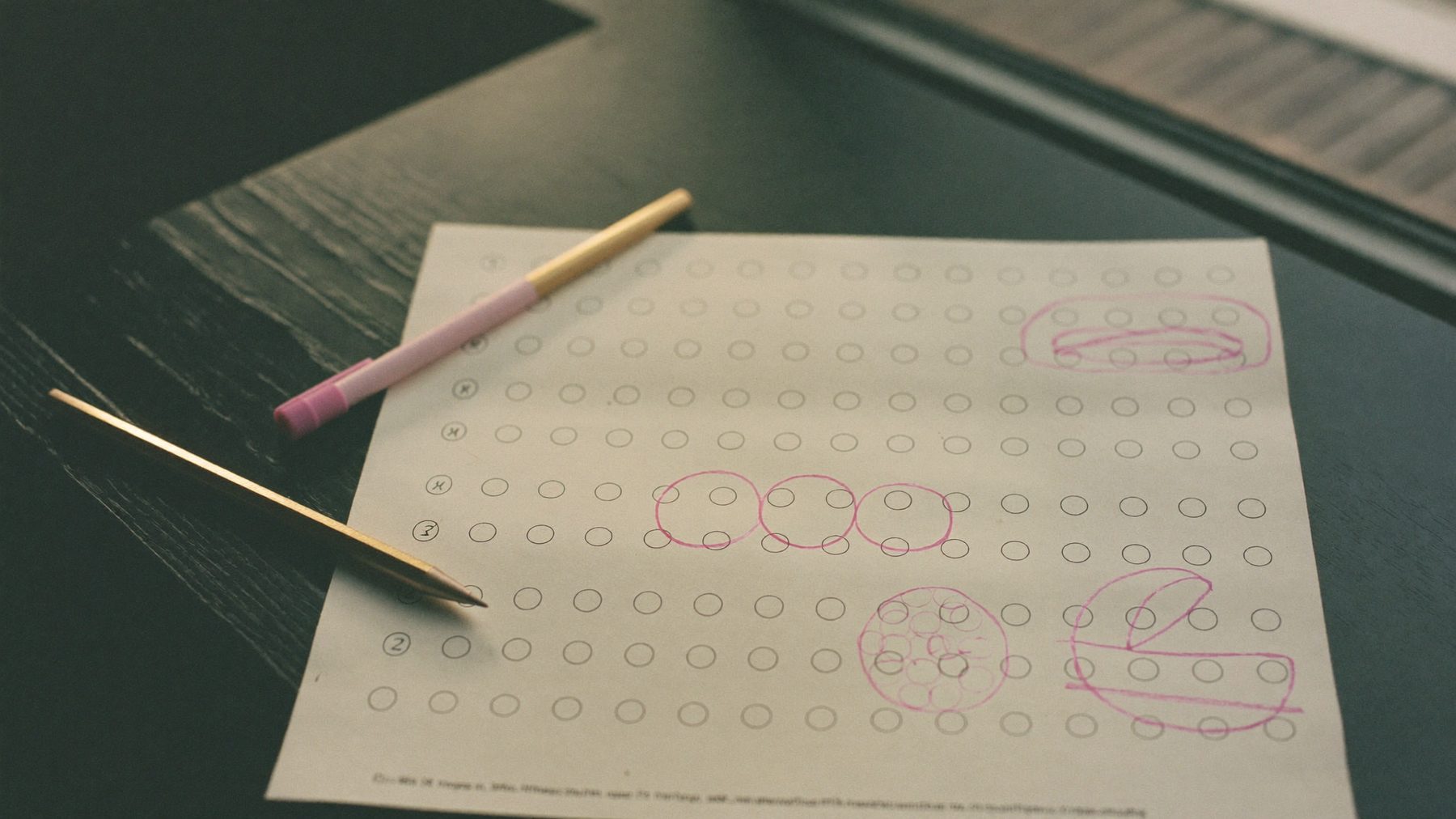
A blank answer sheet with a few bubbles circled in pink, a pink pen and a gold pencil.

Think giant. Work small.

Every program is the same three steps, because the steps are the method. What changes is which four or five question types we spend the weeks on.

1

The first hour

Rick reads the most recent score report or runs a short diagnostic set, live. By the end he can name the question types costing the most points and what a realistic target looks like. For SAT and ACT this hour is free. For the LSAT it follows a full-length proctored diagnostic.

2

The pattern report

A one-page write-up: the four or five leaks, why each happens, the target in writing, and a week-by-week plan built backward from the test date. You keep it whether or not you enroll.

3

The program

Two private sessions a week, a proctored full-length test every week reviewed question by question, and between sessions Giant SAT Drills serving more of what you miss. Nothing on the schedule exists because a book has a chapter on it.

SAT[score, year]
ACT[score, year]
PSAT[score, year]
GRE[score, year]
GMAT[score, year]
LSAT[score, year]

Who teaches.

Rick [Last name], founder and tutor. Name and scores pending

I scored in the 99th percentile on the tests I teach, and I am the person in every session. There is no roster and no "whoever is free." The tutor who reads your diagnostic is the tutor at the whiteboard in week fourteen.

I will tell you in the first hour what a realistic target looks like. If I don't think I can move your score, I'll say so and point you somewhere better.

TeachesSAT, ACT, PSAT, GRE, GMAT, LSAT
Students at a time[Rick: roster cap]
SessionsOnline with a shared whiteboard, or in person in Austin
Studied[Rick: degree, school]
Tutoring since[Rick: year]

More about Rick

To recordRick to camera at his desk, window light, 2x lens. Script: who he is, his own scores, why he reads every diagnostic himself, and the one sentence he says to every parent in the first hour ("I'll tell you the ceiling before you pay for the climb"). No music. One take if possible.

Giant leaps, one student at a time.

Each card is a photographed score report with the gain written on it in Rick's hand. These are samples until the first real cohort finishes.

Sample case
SAT score reportJunior, Westlake
Diagnostic1190
Official, after 12 weeks1510
Scale400 to 1600
1190 → 151012 wks

Maya, SAT

The pattern. Strong student, mediocre score. Sixty percent of her misses came from four question types: transitions, rhetorical synthesis, and two advanced-algebra patterns that only appear in the hard Math module.

The fix. Two weeks closing those four gaps, then weekly proctored tests so the adaptive hard module felt normal. Reading pace rebuilt around the question, not the passage.

“I stopped reading passages and started reading questions. That was the whole trick.”

Sample case
ACT score reportJunior, Round Rock
Diagnostic27
Official, after 10 weeks34
Scale1 to 36
27 → 3410 wks

Ethan, ACT

The pattern. Ran out of time on every section. Reading finished with eight questions blank. Science dragged the composite down even though he was an A student in chemistry.

The fix. A per-section pacing routine drilled until automatic, Science treated as a data-reading test, English grammar as a short checklist.

“Once I stopped trying to understand the science and just read the graphs, it was a free 10 points.”

Sample case
GMAT score reportMBA applicant, consulting
Diagnostic585
Official, after 10 weeks705
Scale205 to 805
585 → 70510 wks

Victoria, GMAT

The pattern. Two self-study attempts plateaued in the 500s. Data Insights was her lowest section and she was ignoring it to grind quant.

The fix. Treated Data Insights as the main event. Built a review-and-edit strategy for the three edits per section. Sessions scheduled around flights.

“Nobody had told me Data Insights was where the points were. It became my best section.”

Sample case
LSAT score reportSenior, UT Austin
Diagnostic158
Official, after 16 weeks172
Scale120 to 180
158 → 17216 wks

Rachel, LSAT

The pattern. Two prep courses, stuck at 161. Missed the same flaw and necessary-assumption questions every test.

The fix. Argument structures taught as a closed system of about a dozen patterns, drilled until recognized before the stimulus ended. Reading comp rebuilt around structure-mapping.

“Logic is a skill. Nobody had taught me it as one.”

Giant SAT Drills is free. For everyone.

Giant SAT Drills is the adaptive practice app our SAT students use between sessions, open to any student. A three-stage diagnostic finds the skills beating you, every session serves more of what you miss, and every question that beat you comes back until it doesn't.

  • Adaptive diagnostic: easy, medium, then hard only where you earned it
  • A chess-style rating that starts at 1000 and climbs as you beat harder questions
  • Every missed question returns on a schedule until you beat it
  • Report a question you think is wrong, or ask Rick about it from inside the app
Open Giant SAT DrillsNo card, no code. Works on a laptop, tablet or phone.

In their words.Sample quotes

The first hour was the moment it clicked for her. He read her October score report and said, "It's the same six things every time." It was.

Catherine M.Parent, Westlake

I'd plateaued after two self-study attempts. He spotted that I was losing most of my Verbal points to one critical-reasoning pattern.

Kevin O.MBA applicant, finance
Sample text
Catherine M.Mom, Westlake
Today 9:42 AM
SCORES ARE OUT
1530!!!!! She's crying. I'm crying.
She earned every point of that.
Her brother is next 😅
Score-day texts, shared with permission. A real screenshot replaces this.

Who this is for.

For

  • Students who already work hard and can't understand why the score won't move.
  • Families with a specific number in mind: a scholarship cutoff, a program median, a reach school.
  • Working adults who need the GRE, GMAT or LSAT done efficiently around a real job.
  • Anyone who has taken a class or used an app and plateaued.

Not for

  • Anyone looking for the cheapest option. A class or an app is cheaper.
  • Students who won't sit the weekly proctored test. The tests are the program.
  • Families who want the tutor to do the homework. We teach. The student practices.

Questions parents ask first.

Who is the tutor?

Rick, the founder. He scored in the 99th percentile on the tests he teaches and he is the person in every session, start to finish. His scores and background are on the about page.

Which tests are open right now?

SAT and ACT one-on-one, with a free first hour, and the LSAT, which starts with a proctored diagnostic. Small group sessions start February 1 (waitlist). PSAT, GRE, GMAT and MCAT are waitlist for now: join on the test's page and you hear first when it opens. Pricing lives on each test's page.

What happens in the free first hour?

Rick reads the student's most recent score report or practice test with them, live, or runs a short diagnostic set if there isn't one. By the end of the hour you know the four or five question types costing the most points, what a realistic target looks like, and what a program would involve. No card, no obligation, and you keep the write-up.

Online or in person, and when?

Both. Online sessions run on a shared whiteboard with the student's own Bluebook or practice material on screen. In-person sessions are in Austin at [Rick: location]. Sessions run [Rick: days and hours]; most students hold a standing slot twice a week. Reschedule free with [Rick: notice] hours' notice.

How fast can a score move?

Practice scores usually start moving within four weeks and most programs run 10 to 16 weeks depending on the test. The first hour tells you specifically what's realistic for the starting point and the deadline. If the timeline is too short to move the score honestly, Rick says so.

What if the score doesn't improve?

After the diagnostic, Rick names a realistic target score and writes it down. Finish the program, sit the weekly proctored tests, and if your official score comes in under that target, he keeps working with you at no charge until you reach it. If he doesn't think the target is reachable, he says so before you pay for a single session.

How is this different from a class or an app?

A class teaches to the middle of the room. An app drills whatever you tap on. Neither knows that your 1380 is a 1380 for completely different reasons than the next student's. Everything in a Giant Prep program exists because the diagnostic showed it should.

Book the free first hour.

SAT and ACT students: one free hour with Rick, no card, no obligation. Bring the most recent score report if there is one. LSAT starts with a proctored diagnostic and a one-hour debrief. PSAT, GRE, GMAT and MCAT are waitlist.

To recordRick to camera: when he replies, how the first hour or the diagnostic runs, what to bring. Same desk and light as the other videos.
Which test is coming up?
Something else (LSAT, or the PSAT, GRE, GMAT and MCAT waitlists)
Format
Test date

Rick replies by text or email within one business day. No mailing list.

Also: admissions consulting for a handful of families each year, starting with a free 30-minute consultation. The consulting page